Alex: With the run of familiar faces in issue #40, I had to go back to when we last met them all – in some cases, as early as issue #3.
The final one is a bit of a swing, based more on her dialogue (and current Blake-ass-looking partner) than anything else. But, to borrow a bit of internet parlance: huge if true.
Like what we do, and want to help us make more of it? Visit patreon.com/timplusalex and pledge to gain access to exclusive blogs, ebooks, mixtapes and more.
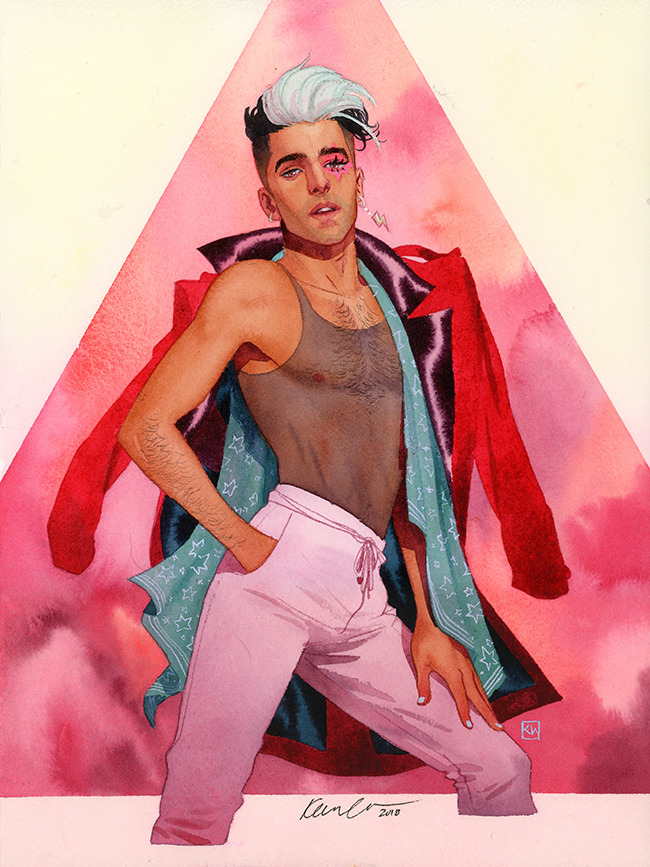
This isn’t the sort of art I normally do, but I wanted a way to thank Taliesin for getting me into The Wicked and The Divine, and I remembered seeing people talking about how Molly was like a WicDiv god and this idea sprang from there!
I’m already so floored by the response this has had on twitter, this fandom is amazing 💜
like a fedora-grabbing Indiana Jones, here’s the second of our two essays on issue #38, looking at the two big monologues that dominate the issue.
Tim: When the first issue of this arc came out, my commentary noted the return of Persephone’s narration, and how its changing role in the
series impacted the way we perceived her actions and motivations. Now, as we
approach the end of this penultimate arc, her narration is one half of a pair
of monologues that (almost) bookend issue #38. At the beginning, we have
Ananke’s drunken ramblings to Robert Graves. At the close of the issue, we have
Persephone’s cryptic remarks and her descent in darkness as she seemingly
vanishes from existence.
These two speeches do more than frame the story in this
issue though. The way the comic presents them, and the way we are encouraged to
engage with them, speaks volumes about the two characters we’re dealing with.
And, as we draw closer to the end of The
Wicked + The Divine, I think they are not only guiding how we are supposed
to interpret these characters, but the series as a whole.
We’ve known the claim has been bunk for a good long while, but let us return to Ananke’s claim that the recurrence moves civilization forward.
Now, obviously we’ve realized that these are almost certainly lies and that the recurrence has mostly been a vehicle through which Ananke continues her existence. But in issue #38, Ananke gave a curious response to Minerva.
In the same issue, it was revealed that the letter from Ananke shown in issue #28 was meant for Minerva. An early bit: “This century is all it threatened to be. It is harder than ever.”
There are more examples throughout the books, but it had long been apparent that Ananke felt that the 21st century had made her task harder than ever.
But issue #38 was the first time when she remarked that perhaps it wouldn’t keep getting harder.
Enter “1373: The Transubstantiation of Lucifer.” Yes, there are small things to learn, such as two years clearly not being an absolute rule. But the real revelation is that Ananke has intentionally wrought mass destruction upon civilization in the name of making her job easier.
All this, of course, raises the question as to what other humongous historic disasters Ananke might be party to. I’d heavily recommend thumbing through @twatd‘s 6,000 Years of Murder for ideas (my mind instantly jumps towards the Indus Valley).
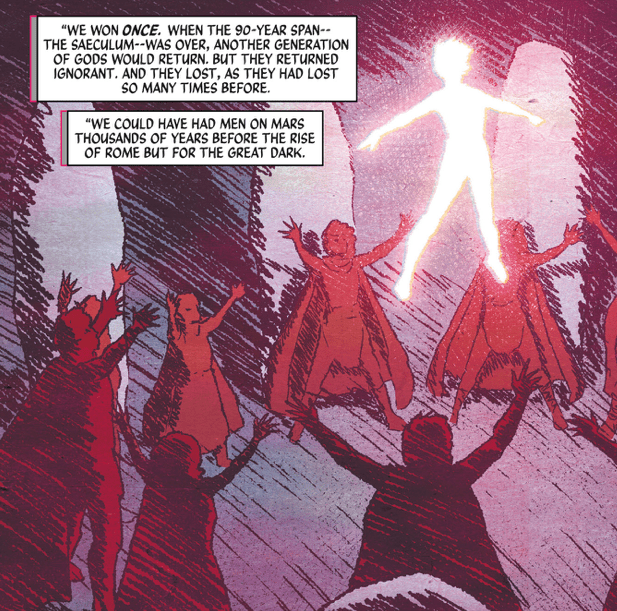
Once upon a time, Ananke told Cass that we could have had men on Mars thousands of years before the rise of Rome but for The Great Dark.
Then she says that she’s the remedy to this shortcoming.
But Ananke’s relationship with civilization is, in truth, much closer to that of her story’s Great Dark.
Alex: Examining Ananke’s claims in #9 has been on our to-do
list for a while now, so thanks to @bookofpoems for handling it for us.
(And with a bonus TWATD namecheck to boot!)
This is something I wrote about a little in my last essay,
but the only real signs of lasting impact that any Recurrence (and by
extension Ananke) has left on the world are the Black Death and World
War Two. Not the greatest indicators of progress.
Also, that
flashback image, with its stone circle, seems to imply the Recurrence
began in Europe? Standing stones do predate the druidic tradition (appearing as
early as 3000BC) but don’t go as far back as the Sisters’ game of stories
(roughly 4000BC).
Once more, for the final time on “Mothering Invention”, we return. As is traditional when we reach the end of an arc, we’re both writing big sweeping looks at some of the series’ underlying themes. Starting with: legacy.
Alex: At the heart of WicDiv’s
premise, there is a deal. A severely shortened lifespan, in exchange for
artistic immortality – or immediate fame and fortune, if you want to look at it
that way. And a lot of the series, as it’s developed over the past four years,
has been asking: who the hell would be willing to strike that deal?
Being completely honest, at some points during those years –
I’ve thought that maybe I would. Not for the fame or fortune, so much, but the
idea of creating something that could last beyond myself. ‘Legacy’ has a nice
ring to it, you have to admit.
“Mothering Invention” has examined various ways people
fantasise about achieving immortality. And has made it perfectly clear that
this fantasy is foolish at best – and monstrous at worst.

















 backup blog in case tumblr explodes