It’s been three years since DashCon and Fyre Fest has happened. Meaning that in accordance to the Rule of Three, in another three years, a third and final gathering catastrophe will occur with its own symbol joining the ball pit and concierge stand to create an ungodly trifecta.
The town is beautiful. It’s called Nördlingen and it is one of the few remaining walled cities in Europe. You can see how it was built in a crater from the shape of it.
O sultan, Turkish devil and damned devil’s kith and kin, secretary to Lucifer himself. What the devil kind of knight are thou, that canst not slay a hedgehog with your naked arse? The devil shits, and your army eats. Thou shalt not, thou son of a whore, make subjects of Christian sons; we have no fear of your army, by land and by sea we will battle with thee, fuck thy mother.
Thou Babylonian scullion, Macedonian wheelwright, brewer of Jerusalem, goat-fucker of Alexandria, swineherd of Greater and Lesser Egypt, pig of Armenia, Podolian thief, catamite of Tartary, hangman of Kamyanets, and fool of all the world and underworld, an idiot before God, grandson of the Serpent, and the crick in our dick. Pig’s snout, mare’s arse, slaughterhouse cur, unchristened brow, screw thine own mother!
So the Zaporozhians declare, you lowlife. You won’t even be herding pigs for the Christians. Now we’ll conclude, for we don’t know the date and don’t own a calendar; the moon’s in the sky, the year with the Lord, the day’s the same over here as it is over there; for this kiss our arse!
– Koshovyi otaman Ivan Sirko, with the whole Zaporozhian Host.”
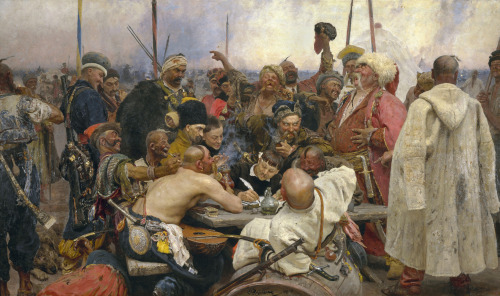
Reply of the Zaporozhian Cossacks to Sultan Mehmed IV of the Ottoman Empire
In case anyone needed a dramatic reading of the above historical letter.
I’m dying!
Oh my god.
I’m now dying to know what happened next.
Period invective at its finest, even if it may not be quite as period as you think.
(NB – Peter Capaldi’s reading is probably NSFW without headphones.)
Here’s a link to much larger versions of the painting. Take a look at the full-size one: the facial expressions are a treat.
Also, check out Repin’s later, revised but uncompleted “sketch” version, which seems to have Vlad Dracula as a guest star just right of centre.
Listening to Capaldi’s reading you can really imagine this crowd of bros around a table yelling at the guy with the pen not to forget their favourite insult.
Tag yourself–I’m “don’t know the date and doesn’t own a calendar”
When I wrote that initial tweetstorm, I hadn’t finished all my research into her. It’s important to not leave out: Marie Equi was physically abusive and she almost certainly either cheated on her wife or went outside the bounds of their non-monogamous agreements. She was a deeply difficult, very flawed, very human person and one shouldn’t lose sight of that when talking about her.
A Pennsylvania museum has solved the mystery of a Renaissance portrait in an investigation that spans hundreds of years, layers of paint and the murdered daughter of an Italian duke.
Among the works featured in the Carnegie Museum’s exhibit Faked, Forgotten, Found is a portrait of Isabella de’Medici, the spirited favorite daughter of Cosimo de’Medici, the first Grand Duke of Florence, whose face hadn’t seen the light of day in almost 200 years.
Isabella Medici’s strong nose, steely stare and high forehead plucked of hair, as was the fashion in 1570, was hidden beneath layers of paint applied by a Victorian artist to render the work more saleable to a 19th century buyer.
The result was a pretty, bland face with rosy cheeks and gently smiling lips that Louise Lippincott, curator of fine arts at the museum, thought was a possible fake.
Before deciding to deaccession the work, Lippincott brought the painting, which was purportedly of Eleanor of Toledo, a famed beauty and the mother of Isabella de’Medici, to the Pittsburgh museum’s conservator Ellen Baxter to confirm her suspicions.
Baxter was immediately intrigued. The woman’s clothing was spot-on, with its high lace collar and richly patterned bodice, but her face was all wrong, ‘like a Victorian cookie tin box lid,’ Baxter told Carnegie Magazine.
After finding the stamp of Francis Needham on the back of the work, Baxter did some research and found that Needham worked in National Portrait Gallery in London in the mid-1800s transferring paintings from wood panels to canvas mounts.
Paintings on canvas usually have large cracks, but the ones on the Eleanor of Toledo portrait were much smaller than would be expected.
Baxter devised a theory that the work had been transferred from a wood panel onto canvas and then repainted so that the woman’s face was more pleasing to the Victorian art-buyer, some 300 years after it had been painted.




 backup blog in case tumblr explodes